
Event: 2026 Yangyang Riverside National Marathon – YRUN
Date: Saturday, September 12, 2026
Location: Yangyang-gun, Gangwon Province, South Korea — from the Namdaecheon River to the East Sea coast
Weather: 16–25°C, mostly cloudy
My first attempt at a half marathon as a beginner runner.
I started running last summer and completed my first 10K race at the Chuncheon United Marathon in the fall. It was fun, but 10 kilometers ended much sooner than I expected, and I was left wanting a little more. That was when I started thinking, “Maybe I should try a half marathon next year.”
As soon as 2026 began, I signed up for two half marathons—one in the spring and another in the fall.
And, as usual, getting too ambitious caused trouble.
I wanted to run faster, so I started doing interval training. About a month later, I injured my knee. Running was put on hold, and I had to give up the Seoul Shinmun Half Marathon that I had planned to run in May.
For a while, I focused entirely on cycling. I had an important event coming up in June: the Seorak Gran Fondo.
Interestingly, my knee pain would disappear quite quickly whenever I rode my bike. So even though I couldn’t run, I was at least able to maintain my fitness.
Running, however, was still difficult, and my return kept getting pushed back. I started wondering whether I might have to give up the fall half marathon as well.
Returning to Running and Preparing for the Half Marathon
The Seorak Gran Fondo took place in June.
I had trained for months and had a personal goal in mind, but heavy rain poured down on race day. In the end, the event was shortened, which was a huge disappointment after all that preparation.
Still, riding Seorak in pouring rain became an experience I probably won’t forget.
With that big event behind me, I could finally start thinking seriously about whether I would be able to run the fall half marathon.
By early July, my knee seemed to have recovered quite a bit, so I cautiously started testing whether I could run again.
At first, I treated it almost like rehabilitation. I ran only 3–4 kilometers at an easy pace, keeping the effort low enough that it wouldn’t put too much stress on my knee.
Then, while carefully watching how my knee responded, I gradually increased the distance.
The most important rule was simple: don’t get greedy and get injured again.
By early August, I was able to run 10 kilometers again. It had been almost exactly a month since I returned to running.
I had never been particularly fast even before the injury, but now even my old pace felt difficult. My heart rate stayed fairly low, but I was constantly worried about the knee starting to hurt again, so I couldn’t help being cautious.
Still, I began to think that if I ran slowly enough, maybe I could finish the race in September.
One week before race day, I did my final long run and extended the distance to 15 kilometers.
My average pace was almost exactly 7:00/km.
It was a little disappointing, but even that pace felt fairly hard. Every time I tried to increase the intensity, my body seemed to send me a warning:
Don’t.
There was no reason to push any harder.
Ideally, I would have liked to run around 20 kilometers at least once before the race. But with only one week remaining, there was no point taking that kind of risk.
For the final week, the goal was no longer training.
It was simply to recover completely and arrive at the start line in the best condition possible.
Race Day – Before Sunrise
Finally, race day arrived for the 2026 Yangyang Riverside National Marathon, also known as YRUN, held in Yangyang, Gangwon Province, South Korea.
Because the shuttle bus was scheduled to leave Seoul at 6:00 a.m., I went to bed early the night before.
I woke up at 3:30 a.m. and started getting ready.
After arriving at Jamsil Sports Complex, where the shuttle buses were departing, I stopped at a convenience store and had a triangle-shaped rice ball for a quick breakfast.
Then I went looking for my bus.
The problem was that the YRUN shuttle buses weren’t the only buses there.
Apparently, there were other events taking place that day as well, and the area was packed with buses. So there I was, wandering around before sunrise trying to figure out which one I was supposed to board.
Eventually, I found the right bus.
Once I got on, I slept almost the entire way to Yangyang.
Well… almost. My throat was a little sore, so I woke up a few times.
After about two hours and twenty minutes, we arrived in Yangyang.
My first stop was, once again, a convenience store. I ate a sandwich, then took one energy gel about an hour before the start. I put another gel in my pocket to eat during the race.
Arriving at the Race Venue
The race venue was Namdaecheon Sports Park in Yangyang.
It was colder than I expected.
I had already put my running clothes on underneath, so all I needed to do was take off my outer layers. But in the chilly morning air, I wasn’t exactly eager to do that.
After attaching my race bib and checking my bag, I headed toward the event stage.
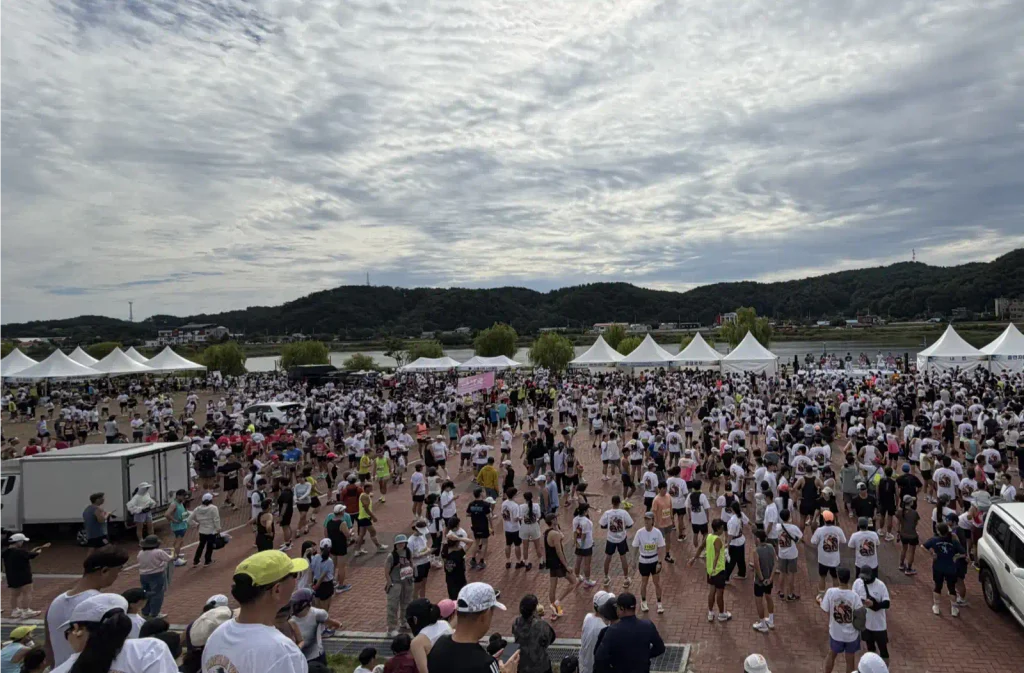
As the start time approached, though, the cold disappeared surprisingly quickly.
It wasn’t hot, and it wasn’t cold.
Pretty much perfect weather for running.
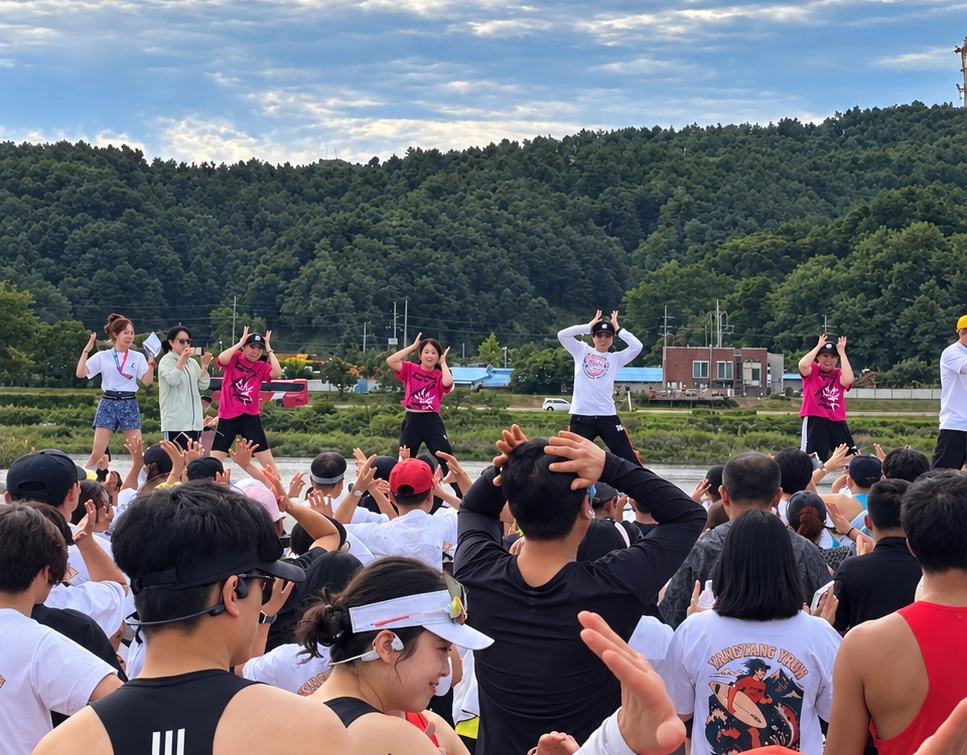
Before the race, there was a group warm-up session—and even some dancing.
I did my best to follow along, but somehow my upper and lower body seemed to be moving independently of each other.
Very awkwardly.
The half-marathon runners were called to the start line first.
I followed the crowd toward the starting area and tried to get myself mentally ready.
The Course
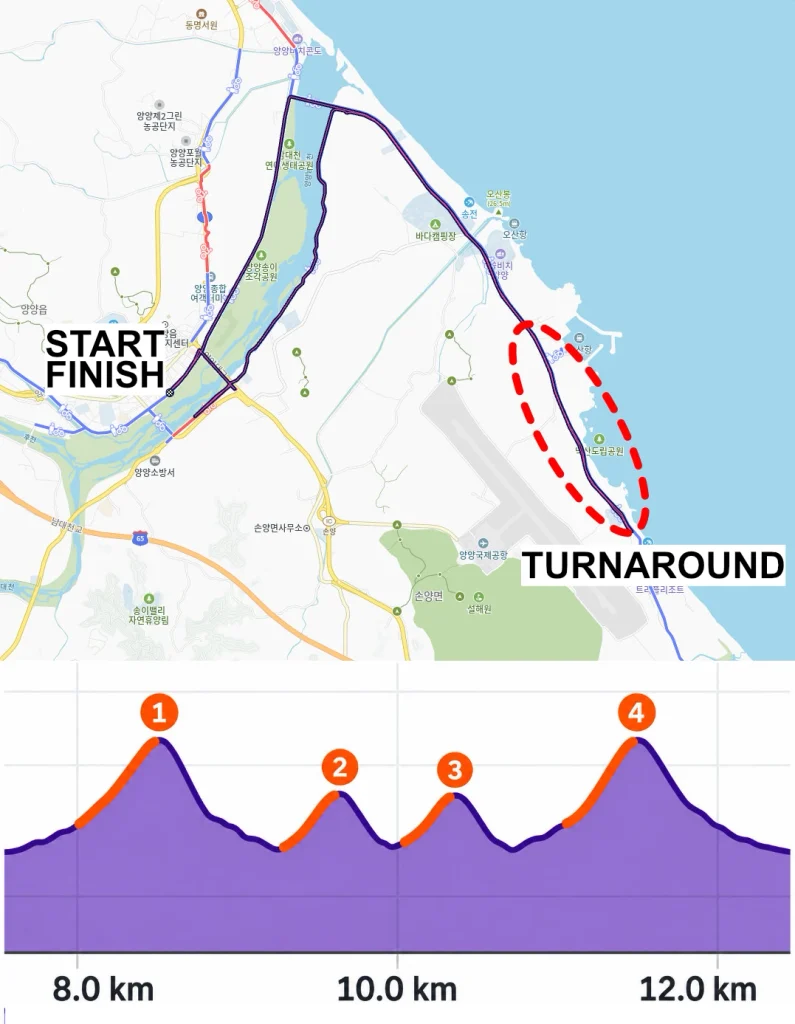
The half-marathon course of the 2026 Yangyang Riverside National Marathon starts in front of the Yangyang Welcome Center, just behind Namdaecheon Sports Park.
From there, runners follow the northern side of the Namdaecheon River for around 3–4 kilometers before crossing Naksan Bridge.
The course then continues along the coastal road near the East Sea before reaching the turnaround point.
After turning back, runners return toward Namdaecheon and follow the southern side of the river back to the finish.
The total distance is the standard half-marathon distance of 21.0975 kilometers.
There are two fairly long climbs beginning around the 7–8 kilometer mark.
Since this section is an out-and-back course, that means you eventually have to climb them four times in total.
The Goal
For a little over two months, I had been trying to rebuild my running fitness as carefully as possible.
During my final 14–15 kilometer training run, an average pace of around 7:00/km felt close to my current limit.
When I first returned to running, my only goal had been to finish without getting injured.
But by race week, I had managed to run 15 kilometers again, so I decided to give myself a time goal as well.
Using the 7:00/km pace from that final test run as a reference, I set my target at:
Finish within 2 hours and 30 minutes.
Half, Go!!!
And finally, we were off!
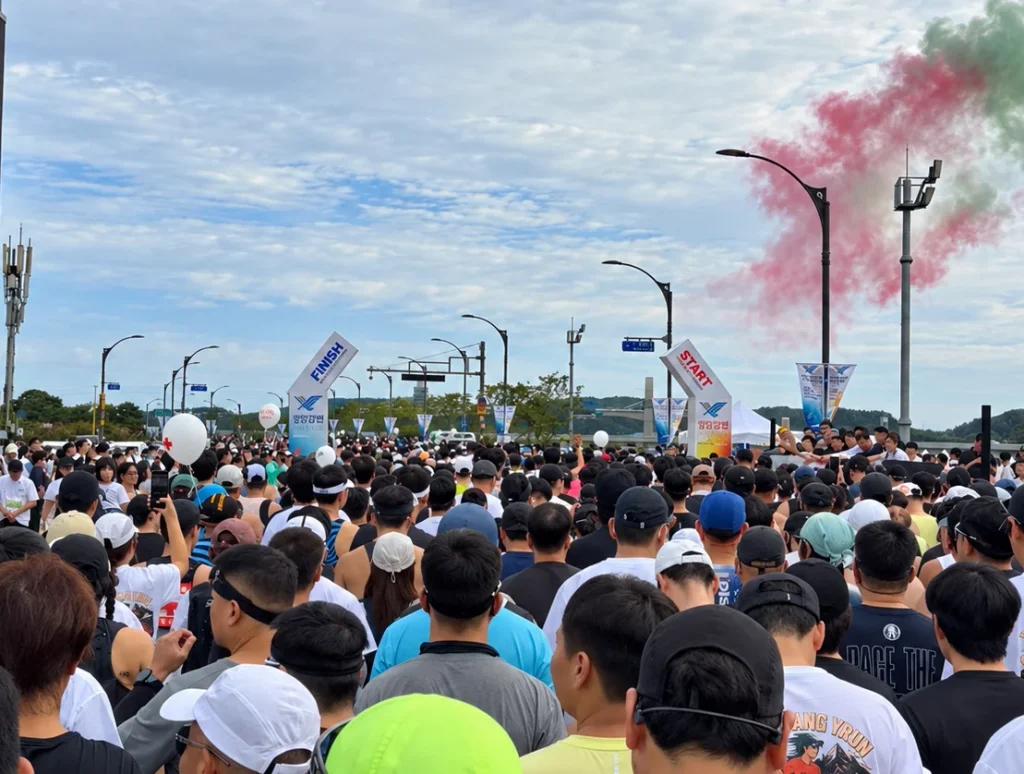
For the first 3.5 kilometers or so, we followed Ilchul-ro along the northern side of the Namdaecheon River toward Naksan Bridge.
After crossing the bridge, we entered Seonsa Yujeok-ro, the coastal road section of the course.
The air was still cool.
I checked my watch and noticed that I had been running at a little over 6:00/km.
Was it the race atmosphere?
Or does drafting somehow work in running when you’re surrounded by this many people?
I felt like I was running comfortably, but somehow I was moving much faster than expected.
5 km
I passed the 5-kilometer mark.
So far, I still felt great.
My pace hadn’t dropped, and I continued to run in the low-6-minute-per-kilometer range.
It wasn’t hot, and my body felt relaxed.
At one point, I spotted a runner wearing a dinosaur costume.
It reminded me of someone I used to see often at cycling gran fondos, always riding in a bee costume.
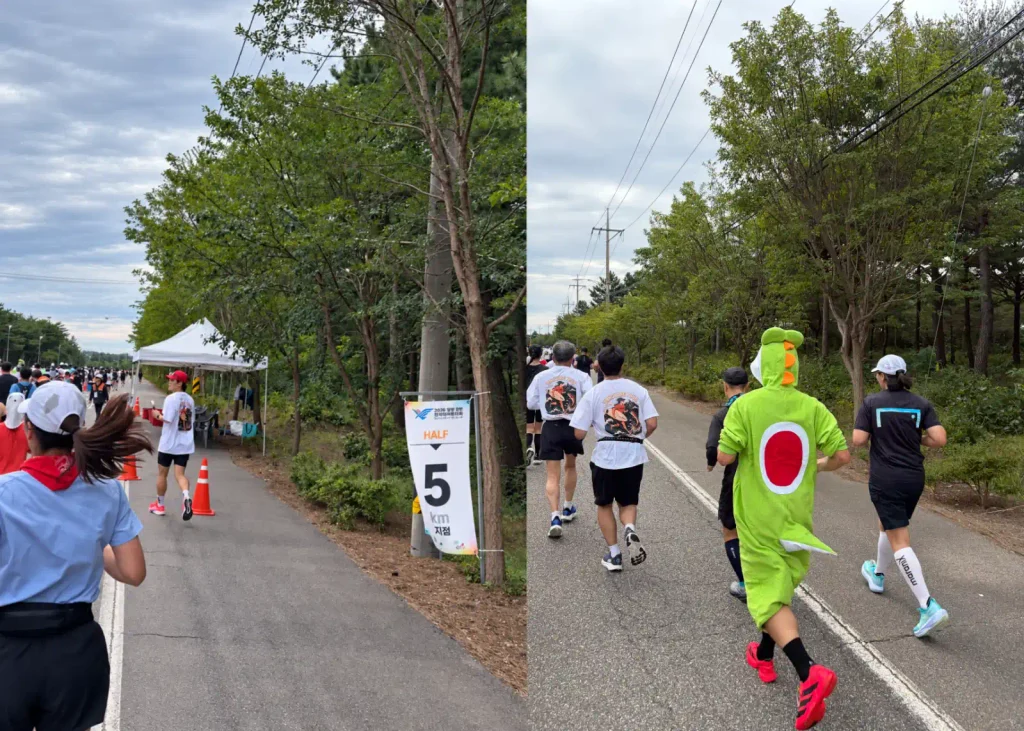
Somewhere around the 6–7 kilometer mark, an official race vehicle came toward us from the opposite direction, noisily clearing the course.
The lead runner had already reached the turnaround point and was on the way back.
He was probably about six kilometers ahead of me.
If you do the simplest possible math, that meant he was running almost twice as fast.
At that point, it didn’t even feel like, “Wow, he’s fast.”
It felt more like he belonged to a completely different world.
The First Climb
Just after the 7-kilometer point, the first of the four long climbs appeared.
The gradient itself didn’t seem particularly steep, but the climb felt surprisingly long.
My heart rate started to rise and my breathing became noticeably heavier.
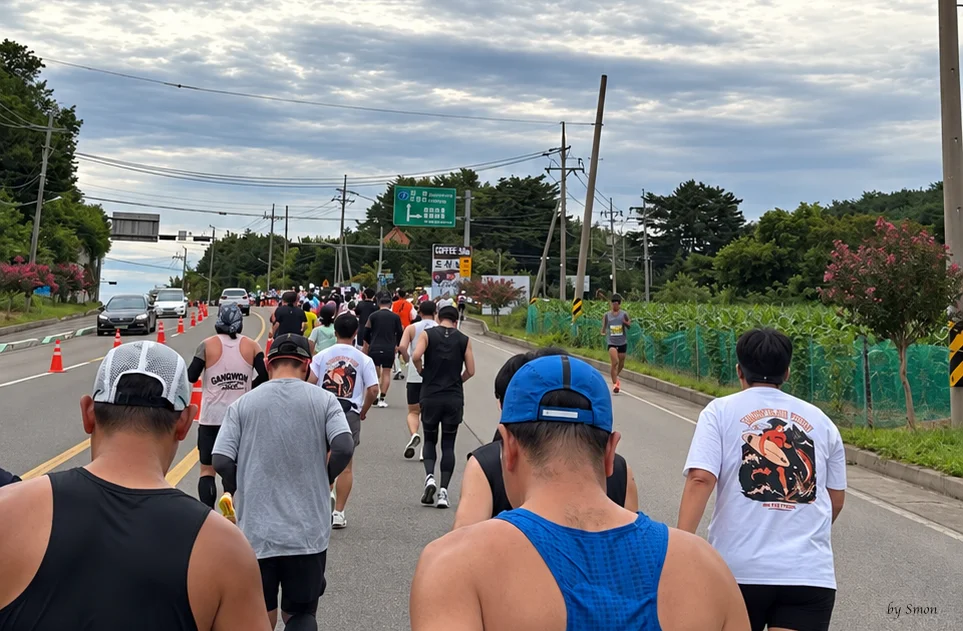
Around the 9-kilometer mark, the second climb began.
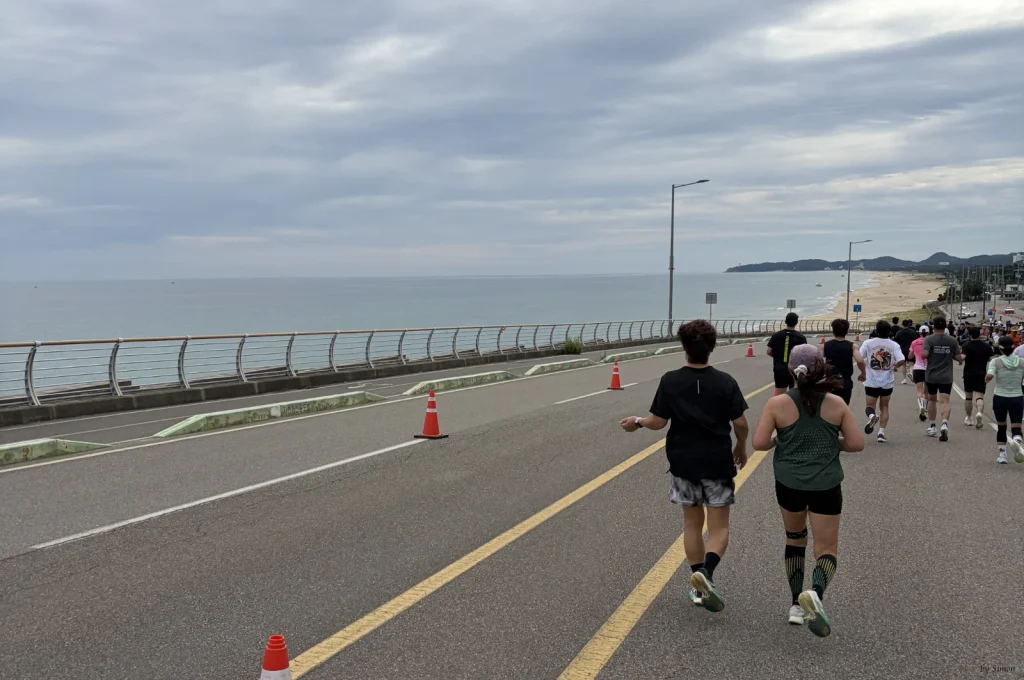
Once I reached the top, the East Sea suddenly came into view.
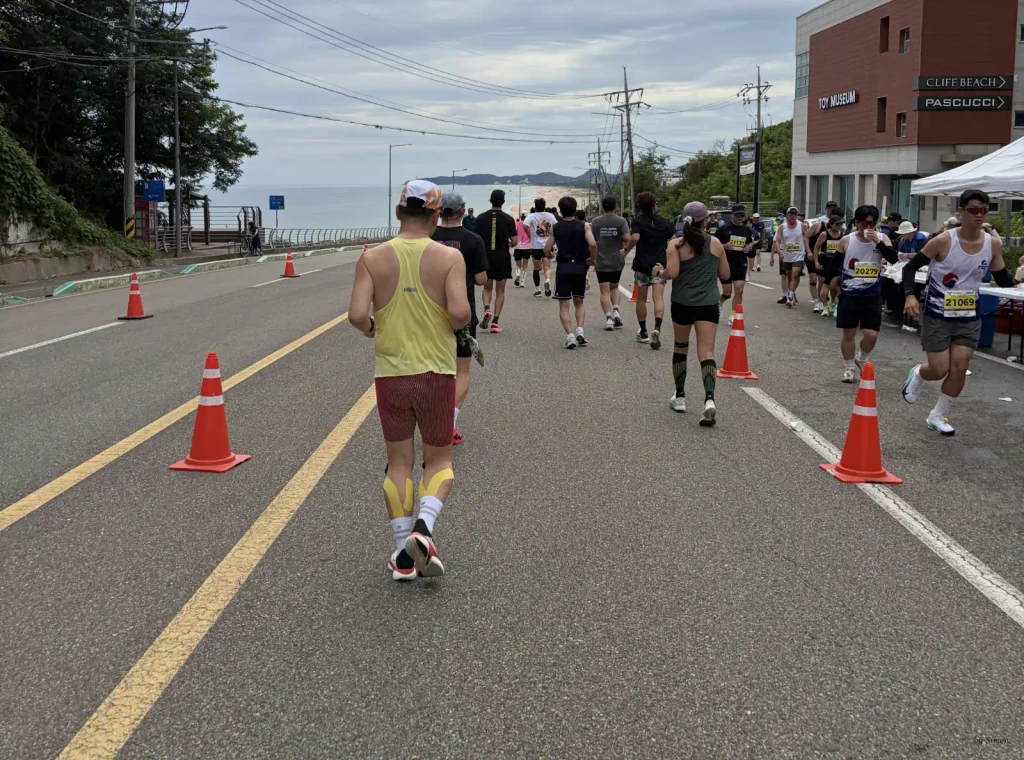
The ocean looked beautiful.
Normally, seeing the sea like that would immediately put me in a good mood.
But at that moment, I wasn’t really appreciating the scenery very much.
All I could hear around me were runners groaning.
The Turnaround
Finally, the turnaround point.
It came a little before the 10-kilometer mark, and I was still maintaining my pace.
Just before the next water station, I ate the energy gel I had brought with me.
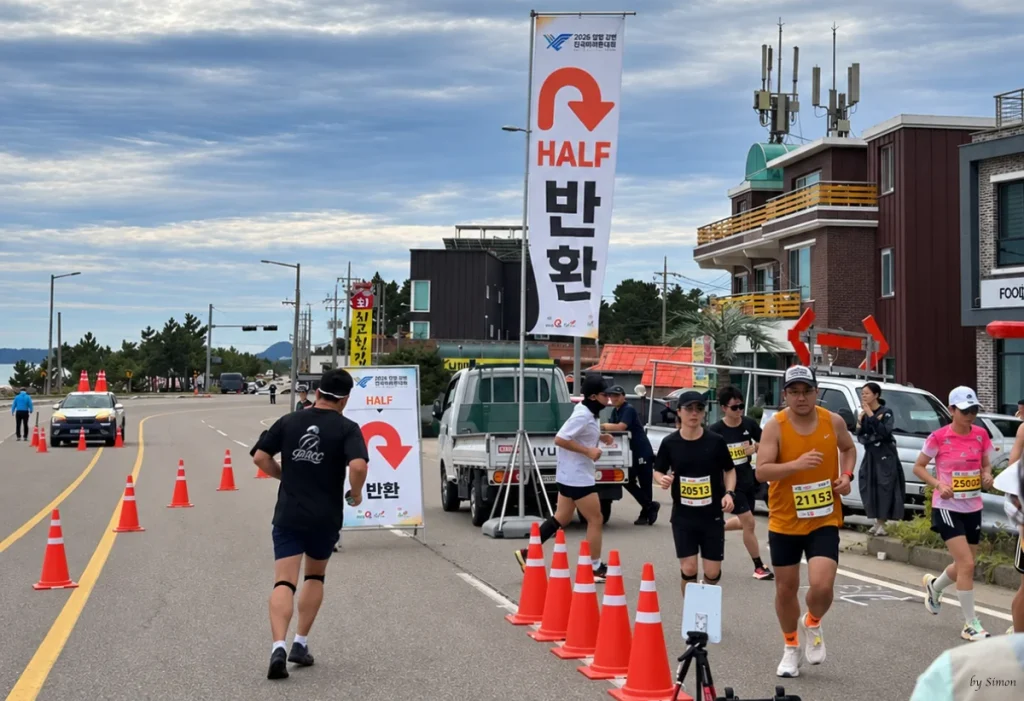
The moment I made the turn, I had to climb straight back up the hill I had just descended.
And then came another climb.
By the time I had completed all four climbs on the out-and-back section, I had covered roughly 12 kilometers.
From there, most of the remaining course was relatively flat.
Each time I climbed, my heart rate rose higher and higher, eventually approaching my peak.
Still, I never had to walk or stop, and I managed to maintain almost the same pace.
Maybe all those years of enjoying climbs on a bicycle helped a little. At least uphill effort itself felt familiar.
After the final climb, I kept running until I spotted the 2:10 pacers ahead of me.
I decided to try following them.
And Then the Pain Started…
Around the 15-kilometer mark, Naksan Bridge came back into view.
On the return route, instead of crossing the bridge again, the course turns left and follows the southern side of the Namdaecheon River.
Up to that point, I had been running almost unbelievably comfortably.
Training had felt so hard, yet somehow race day was different.
Then, at around 16 kilometers, my body finally started sending signals.
Things were getting uncomfortable.
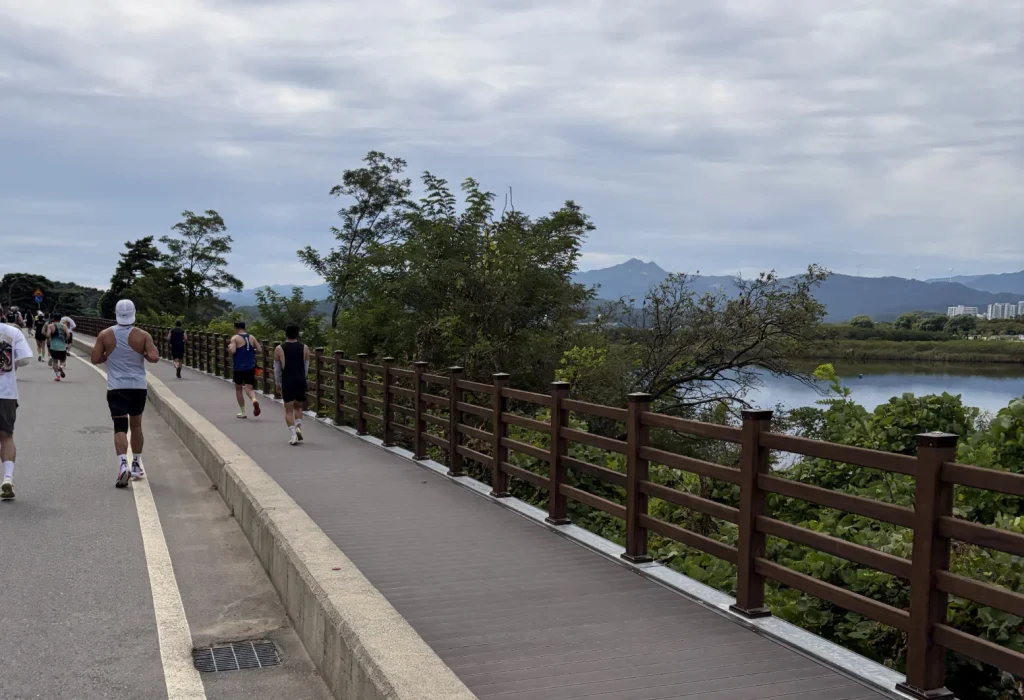
At 17 kilometers, I entered completely new territory.
The longest distance I had ever run before was 17 kilometers.
Once I passed 19 kilometers, things became genuinely difficult.
That was the second major low point of the race.
There were only about two kilometers left, but suddenly those two kilometers felt incredibly long.
Finish
I crossed Yangyang Bridge.
500 meters to go.
I was exhausted, but after getting this far, I decided to squeeze out whatever I had left.
The finish line was visible in the distance.
Time to use every last bit of energy.
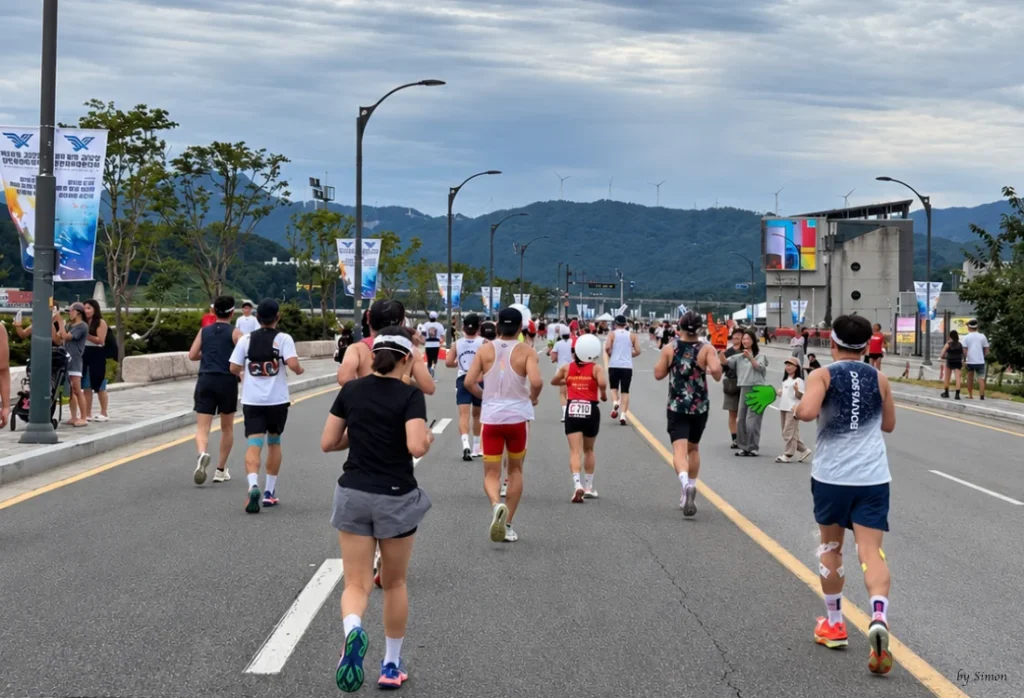
Finally…
Finish!
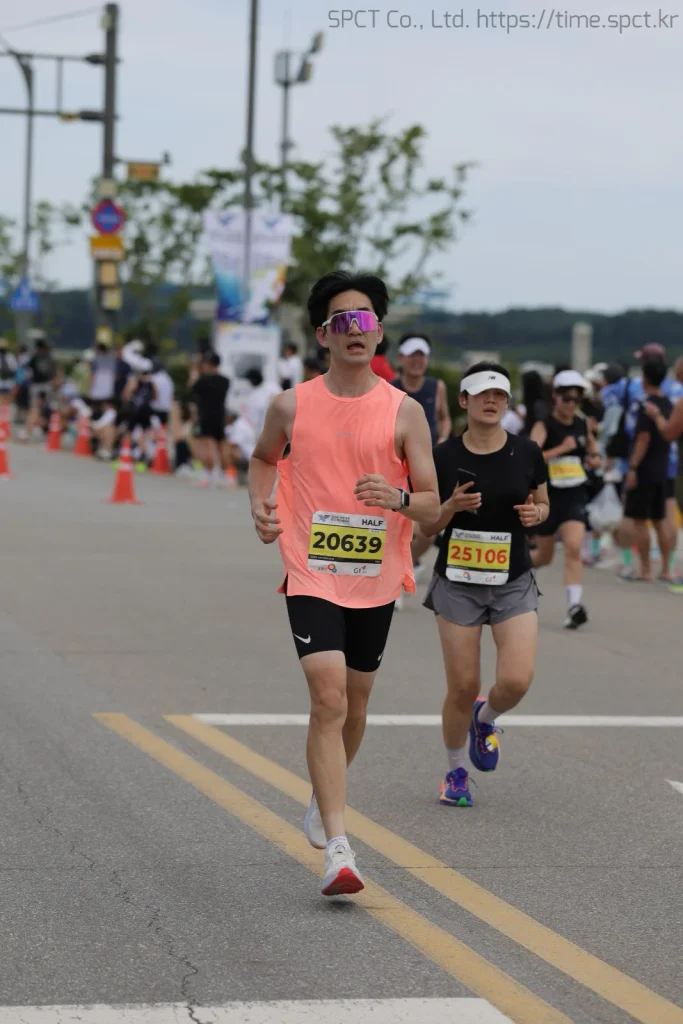
The moment I crossed the line, I completely forgot about doing any kind of recovery jog.
I immediately started walking.
It was finally over.
After the Race
I headed back into the event area.
Finishers received a medal and a small race gift.
There were some snacks—and, interestingly, a one-kilogram bag of rice.
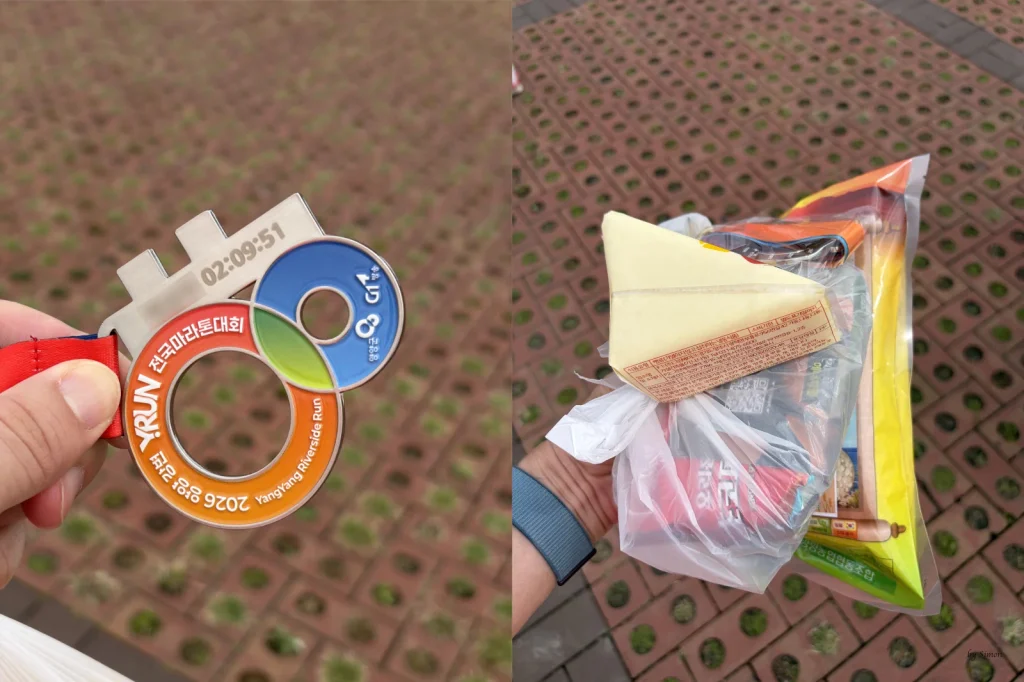
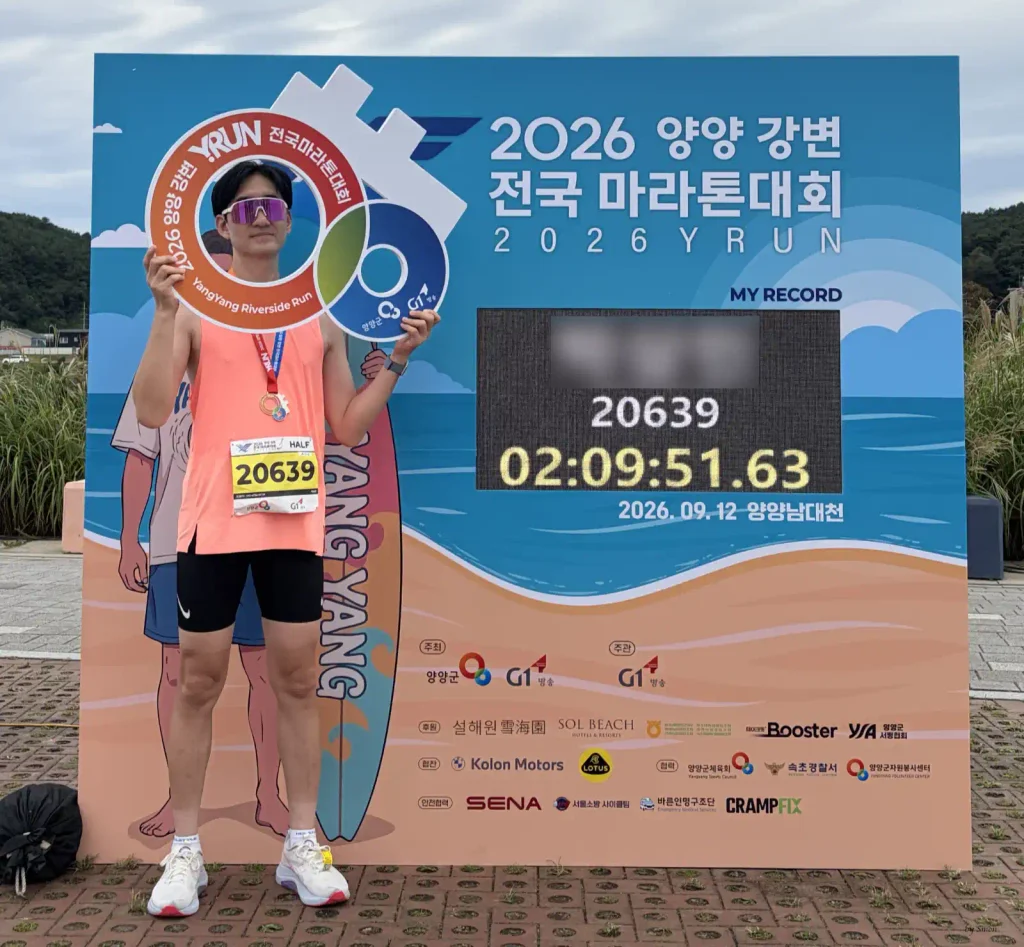
And of course, a commemorative photo.
In the end, photos are what remain.
I’m not a fast runner, but this was my first half marathon, so I decided to have my finishing time engraved on the medal as a souvenir.
Then I sat down for a while, rested, and ate the snacks they had given me.
They weren’t nearly enough to fill me up.
After collecting my bag and changing clothes, I walked across the road to Yangyang Traditional Market.
First, I bought some dakgangjeong—Korean sweet and crispy fried chicken—to take home.
Then I had a bowl of jang-kalguksu, a spicy local-style noodle soup, for a proper meal.
After that, I got back on the shuttle bus…
and immediately fell asleep again.
Having a shuttle bus really was convenient.
If I had driven all the way to Yangyang myself, the trip back to Seoul would have been pretty miserable after the race.
Result and Final Thoughts
My finishing time for my first half marathon was:
2:09:51
That was about 20 minutes faster than my target.
Personally, I was extremely happy with the result.
Looking at my average heart rate afterward, I probably could have pushed my cardiovascular system a little harder.
But my main concern was never my heart or lungs.
It was my knee.
If I had pushed harder, maybe my knee wouldn’t have survived the race quite so well.
During training, whenever I ran more than 10 kilometers, my pace usually ended up somewhere between the high-6-minute and low-7-minute-per-kilometer range.
So I had honestly wondered whether even 2 hours and 30 minutes might be close.
But on race day, I was already running in the low-6-minute range from the beginning, and surprisingly, my pace never collapsed badly toward the end.
Was it the good weather?
Was it the atmosphere of the race?
Probably a bit of both.
More than anything, though, I was relieved that my knee—the thing I had worried about most—held up all the way to the finish.
I had already decided that I would walk if my knee couldn’t handle it, so finishing the entire race without having to do that was a huge relief.
I also liked the course.
Starting beside the Namdaecheon River, passing Naksan Bridge, and then reaching the East Sea meant that the scenery kept changing throughout the race.
Even over 21 kilometers, I never really felt bored.
That is very different from my normal training runs, where boredom is often one of the biggest battles.
Of course, the four climbs were tough.
And the final five kilometers were very tough.
Still, I think I finished my first half marathon in the best possible way.
And after finally running one, I realized something once again…
A full marathon is probably still not for me. ^^
But if my body and schedule allow it, I’d like to come back and run a half marathon about once a year.
by Simon