
Event: 2026 SENA Seorak Granfondo
Date: Saturday, June 20, 2026
Weather: 19–21°C (66–70°F), Heavy Rain
My result at the 2025 Seorak Granfondo was 10 hours, 1 minute, and 43 seconds—just 1 minute and 43 seconds short of my goal of finishing under 10 hours.
Normally, I’m the kind of rider who enjoys the experience of a granfondo more than chasing a finish time. But after riding the Seorak Granfondo several times, I gradually found myself wanting to see how much faster I could become. Missing my goal by such a tiny margin last year stayed in my mind for a long time. I couldn’t stop thinking, “If only I had done just a little better…”
If I had achieved my goal last year, I probably would have returned this year simply to enjoy the scenery and the atmosphere without worrying about my time. Instead, the opposite happened. Those missing 103 seconds became the biggest reason I decided to prepare for Seorak once again.
Rebuilding My Fitness During the Winter
The second half of last year was difficult.
Not only did my fitness decline, but so did my motivation to train. My FTP also dropped to its lowest level in quite some time.
During the winter, I went back to basics with indoor training, focusing on rebuilding my endurance and overall fitness. Rather than chasing high numbers, I concentrated on consistently regaining the condition I had lost.
Then the schedule for the Seorak Granfondo changed.
The event, originally planned for May, was postponed to June 20, giving me several extra weeks to prepare.
However, the unusually long winter meant that I couldn’t begin riding outdoors until April, nearly a month later than usual.
My early-season schedule looked like this:
- April 7, 2026 – Long Ride – 204 km / 1,040 m – Randonneurs Seoul–Yeongjong Island Cycling Path
- April 11, 2026 – Event – 125 km / 2,140 m – Wonju Cherry Blossom Granfondo
- April 18, 2026 – Hill Training – 100 km / 1,354 m – Six Climbs in Eastern Gyeonggi Province
- April 25, 2026 – Long Ride – 204 km / 1,255 m – Randonneurs “Gaori Fishing” Ride
An Unexpected Setback
Just as everything seemed to be going according to plan, something unexpected happened.
While doing running interval training, I injured my knee. The injury forced me to stop proper training for nearly three weeks.
The pain lasted much longer than I expected, and eventually I had to give up the half marathon I had been preparing for in May.
During that period, I seriously questioned whether it was still realistic to chase a personal best at this year’s Seorak Granfondo.
Still, I didn’t want to abandon everything I had already worked for.
Instead of forcing myself back into training too soon, I chose recovery first and decided to make the best use of whatever time remained.
On May 16, I got back on the bike for a 132 km flat ride along the Han River to check how my body felt. From there, I gradually increased both my mileage and climbing workload.
The key training rides leading up to the event were:
- May 25, 2026 – Long Ride – 218 km / 2,620 m – Randonneurs “Danjong Adventure”
- May 30, 2026 – Hill Training – 151 km / 2,421 m – Ten Climbs in Eastern Gyeonggi Province
- June 6, 2026 – Hill Training – 150 km / 2,477 m – Cheongpyeong Station–Hwaaksan Loop
These weren’t simply long rides for accumulating distance.
They were opportunities to confirm whether I could maintain a steady pace for several hours and whether my climbing ability had recovered enough for the demands of the Seorak Granfondo.
Looking Back at Last Year’s Data
This year, for the first time, I took a detailed look at the data from my ride in the 2025 Seorak Granfondo.
After reviewing the ride files and analyzing them with the help of AI, I noticed a clear pattern. My power output remained relatively consistent all the way to Hangyeryeong Pass, but it dropped dramatically on the final climb of Yeok-Guryongryeong Pass.
There wasn’t enough evidence to point to a single cause, but the most likely explanation was a combination of insufficient nutrition, inadequate hydration, and my inability to cope with the heat.
I’ve always been someone who doesn’t feel thirsty until it’s already too late. Combined with the unusually hot weather, I simply wasn’t taking in enough fluids or calories. Looking back, it seemed that the accumulated deficit finally caught up with me during the final hours of the ride.
So this year, I changed my race strategy.
Normally, I keep a tool bottle in one of my bottle cages. This time, I switched to a saddle bag so I could carry two full water bottles—one filled with water and the other with an electrolyte drink.
I also stopped relying on thirst or hunger as signals.
Instead, I followed a fixed fueling schedule.
- Take two or three sips of water or electrolyte drink every 15 minutes.
- Consume one energy gel every hour.
- Refill both food and fluids properly at every aid station.
The final test came on June 13, when I completed a 100 km non-stop Zone 2 ride.
The goal wasn’t just to maintain my target power. I also practiced the exact nutrition and hydration strategy I planned to use during the race.
The results were encouraging. My pacing stayed consistent, and my fueling plan worked exactly as intended.
After that ride, I felt that everything was finally ready.
Now, all that remained was race day.
But then…
What Happened to the Weather?
About a week before the event, another unexpected challenge began to appear.
Around Monday, overseas weather models started showing the possibility of rain over the weekend.
At first, the forecast wasn’t too concerning. Most models suggested that rain would begin on Saturday evening and continue into Sunday, while the Korean weather forecast still predicted dry conditions on race day.
At that point, I still hoped the forecast would change.
Unfortunately, things moved in the opposite direction.
By Tuesday, almost every major international weather model agreed that rain would arrive on Saturday, and with each update, the expected start time kept moving earlier.
Ironically, I found myself hoping the rain would pass through a day earlier.
Instead, every forecast update pushed it closer to the race.
By Thursday evening, the Korea Meteorological Administration had also issued a rain forecast, and the predicted rainfall continued to increase as race day approached.
Every time I refreshed the forecast, I hoped for better news.
Instead, it seemed to become a little worse each time.
I Prepared for Heat… Then Had to Worry About the Cold
Throughout my preparation, the biggest challenge I expected to face was the heat.
I’ve always struggled more with hot weather than cold, so after analyzing last year’s ride, I spent a great deal of time thinking about how to avoid another late-race collapse caused by overheating.
Then, just a few days before the event, everything changed.
Instead of worrying about high temperatures, I suddenly had to think about how to stay warm while riding in heavy rain for several hours.
The Seorak course is famous not only for its long climbs but also for its long descents.
With rain falling all day, the wind chill on those descents would be much lower than the actual air temperature. After reaching each summit, staying warm during the downhill sections became a far bigger concern than saving time.
It was a strange feeling.
I’d spent months preparing for extreme heat, only to find myself planning for the exact opposite.
In the End…
On Friday morning, the official announcement finally arrived.
Due to severe weather, the organizers announced that the full Granfondo course would be cancelled, and only the shorter Medio Fondo course would be held.
Reading the announcement made the disappointment feel even more real.
Months of preparation seemed to disappear in an instant.
I had spent the entire winter rebuilding my fitness through indoor training.
Even after my knee injury disrupted my plans, I recovered, returned to long-distance rides, and continued climbing training. Most importantly, I had carefully adjusted every part of my preparation to give myself another chance at finally breaking the 10-hour barrier.
That’s why the cancellation of the full course was so difficult to accept.
To make things even more frustrating, every Saturday from April until race week had brought beautiful riding weather.
“Why did it have to rain on the one day that mattered?”
That thought stayed with me all day.
Still, I Headed for Inje
For a while, I seriously considered not going at all.
The race I had trained for no longer existed, and the predicted rainfall kept increasing. During the hours when I would normally have been climbing the highest passes, the forecast was calling for more than 20 mm of rain per hour.
At that point, it hardly seemed worth making the trip.
But it was already too late to cancel my accommodation.
More importantly, I felt that staying home would leave me with even greater regret.
So I decided to lower my expectations.
“Even if I don’t ride, I’ll at least enjoy the trip.”
With that mindset, I set off for Inje.
Rain began falling almost as soon as I left Seoul.
Watching the rain naturally reminded me of the previous year.
Before the 2025 Seorak Granfondo, it had also rained throughout the day before the event. Rain was even forecast for race morning.
Yet somehow, by the next morning, the rain had disappeared as if nothing had happened, and the event went ahead as planned.
Could the same miracle happen again?
About two hours later, I arrived in Inje and had dinner at the same pork cutlet restaurant I had visited the year before.
The same town.
The same restaurant.
The same motel.
And almost the same amount of rain.
It felt like déjà vu.
I clearly remembered sitting there last year thinking,
“Maybe the rain will stop by tomorrow morning.”
Race Morning
When I woke up the next morning, last year’s miracle hadn’t happened.
Rain was still falling outside the window.
On a normal race day, I would already have been busy preparing from early in the morning.
This time was different.
The full course had already been cancelled, and the steady rain had taken much of the excitement away. Naturally, I found myself getting ready much more slowly than usual.
Even while preparing, I kept checking the weather forecast.
Just the day before, the forecast had predicted more than 20 mm of rain per hour during the time I would normally have been crossing Guryongryeong Pass.
If that forecast had remained unchanged, I had already decided not to start, even on the shorter Medio course.
But when I checked again that morning, the situation had improved slightly.
The expected rainfall had dropped to around 12 mm per hour.
It was still heavy rain, but no longer seemed completely impossible to ride in.
I decided to head to the venue first and make the final decision there.
Only a week earlier, my biggest concern had been the heat.
Now, everything depended on staying warm.
Knowing I would spend hours descending wet mountain roads, I chose a more conservative clothing setup than usual.
For my lower body, I wore my usual lightweight bib shorts, since they dry relatively quickly even after getting soaked.
For my upper body, I layered a sleeveless base layer, a lightweight long-sleeve cycling jersey, a cycling gilet, and a thin rain jacket.
To reduce heat loss, I even placed a thin piece of plastic inside my helmet to keep rain off my head and attached a disposable heat pack to my abdomen.
I’d ridden in similar rainy conditions before, so this setup was based on what I had learned from those experiences.
Heading to the Start Line
I left my motel a little later than usual.
With the rain falling steadily, I assumed many riders would stay home, so I didn’t expect any traffic.
I was wrong.
There were far more cars heading toward the venue than I had expected.
Eventually, I couldn’t drive all the way to the Inje Riding Center.
Instead, I parked near the entrance to Omi Pass and prepared my bike there.
For a while, I simply sat inside the car and watched.
Some people were walking toward the venue.
Others were already turning back without riding at all.
At the same time, more and more cyclists slowly began heading toward the start.
I checked the weather forecast one more time.
The rainfall prediction had dropped again.
The peak rainfall was now expected to be around 8 mm per hour.
“Maybe this is actually rideable.”
“I’ll head to the start line first… then make the final decision.”
So I rolled my bike toward the Inje Riding Center.
And once I got there, I made up my mind.
“I’ve come all this way. I’m riding.”
I couldn’t ride the full Granfondo course as I had hoped, and that disappointment would remain.
But I knew I would regret not starting far more than I would regret riding in the rain.
At the very least, it would become another unforgettable memory.
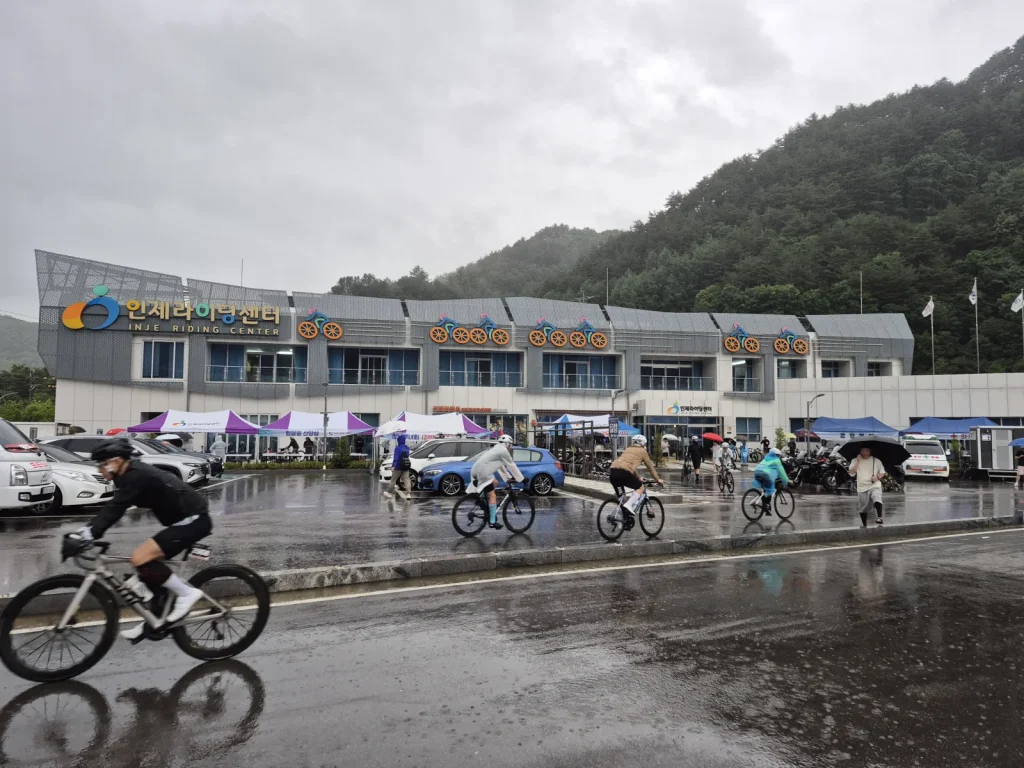
The Race Begins in the Rain
On my way into the event venue, I ran into several familiar faces.
I wasn’t the only one planning to ride the Seorak Granfondo this year. Quite a few friends had signed up as well, and many of them had already made the trip to Inje.
With the weather looking so bad the day before, I honestly expected most of them to give up.
In the end, however, three of us—including myself—decided to start the ride.

On a typical Seorak Granfondo morning, the start line is packed with around 5,000 riders, all waiting for the countdown in an atmosphere filled with excitement and nervous anticipation.
This year couldn’t have been more different.
The official start time had already passed, and many participants had decided not to ride at all. The start line felt surprisingly quiet.

Later, I heard that out of roughly 5,000 registered riders, only 1,100 to 1,200 actually started the event.
Even so, that was still far more people than I had expected would choose to ride in such heavy rain.
On a normal race day, I would have tried to join one of the faster groups to benefit from drafting.
This time, I had no intention of doing that.
Rain reduces visibility and significantly increases braking distance. Even in normal circumstances, I prefer to avoid riding in a pack during wet conditions, so I decided from the very beginning to ride at my own pace.
As soon as the race began, large raindrops continued to strike my face.
The First Climb – Guryongryeong Pass
After riding about 38 km, I reached the first aid station.
One of the friends who had started with me had disappeared from sight long ago, and the other rider behind me was nowhere to be seen either.
With the full Granfondo cancelled and finishing time no longer carrying much meaning, I decided to stop at every aid station along the Medio course.
There were only two of them anyway.

Last year, I had skipped the first aid station because it was overcrowded.
This year, with far fewer riders, I was able to calmly refill my bottles and grab some food without waiting.
After leaving the aid station, the first major climb of the day finally began.
Guryongryeong Pass is approximately 6.4 km long with an average gradient of around 6%.
Although it’s a fairly long climb, the gradient is steady enough that maintaining a consistent rhythm is usually all it takes to reach the summit comfortably.
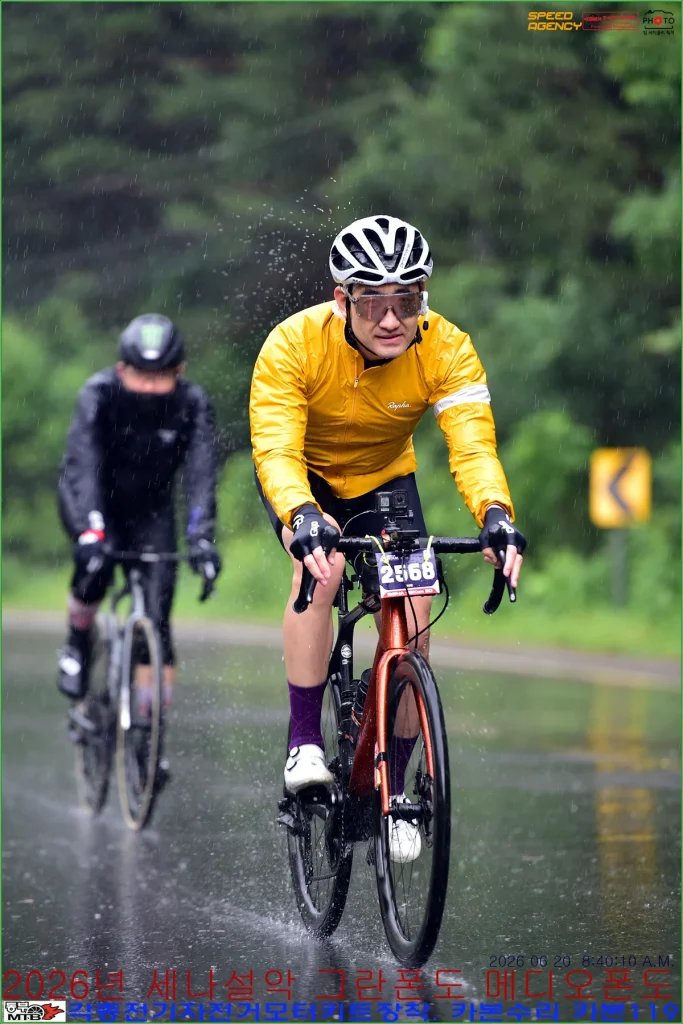
(Photo by Dongbu MTB)
Normally, during the Seorak Granfondo, riders reach the base of Guryongryeong much faster thanks to the large peloton.
This year, I spent most of the approach riding alone, so it took noticeably longer to arrive at the same point.
Still, there was one clear advantage.
At least I wasn’t overheating.
The cool rain made climbing surprisingly comfortable, and I simply settled into an easy rhythm.
Once I reached the summit and passed through the ecological tunnel, the scenery changed completely.
Dense fog covered the entire mountain.
Visibility felt no more than 20 meters.
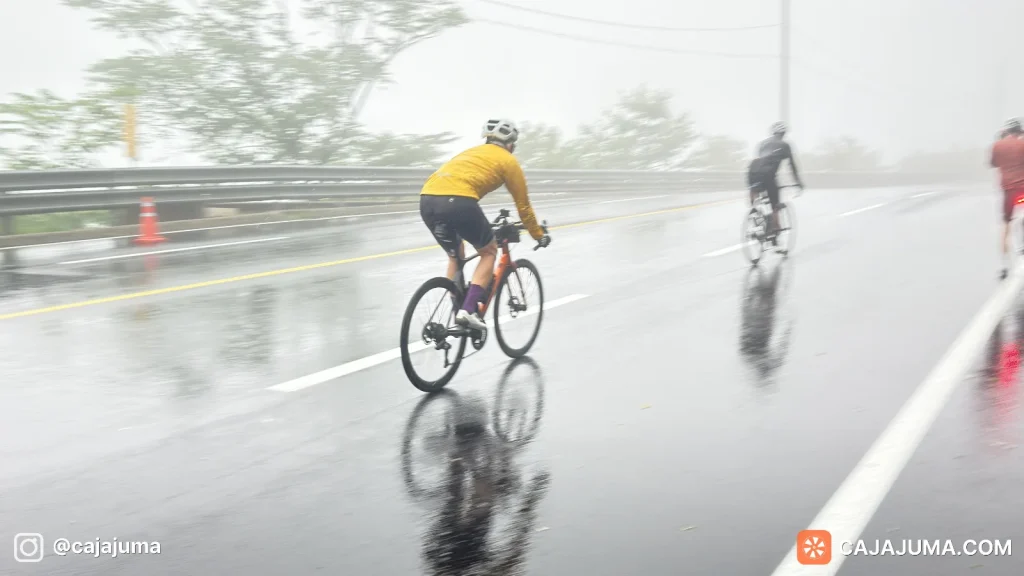
(Photo by Cajajuma)
To be honest, the section I had worried about most before the race wasn’t the climb itself.
It was the descent from Guryongryeong.
Even in dry conditions, many riders descend this road at high speed, making it one of the most demanding sections of the course.
With wet pavement and thick fog, it had the potential to become genuinely dangerous.
Fortunately, the organizers had placed marshals throughout the hazardous sections.
More importantly, every rider seemed to understand the situation.
Everyone descended much more cautiously than usual, leaving plenty of space between bikes.
We were slower than in previous years, but that was absolutely the right choice.
No finish time was worth taking unnecessary risks that day.
Safely completing the long descent, I headed toward the second major climb of the course—Jochimryeong Pass.
Jochimryeong Pass
After the long descent from Guryongryeong, the road soon began climbing again.
The second major ascent of the day was Jochimryeong Pass.
According to my original race plan, I intended to climb at around 190 watts, saving enough energy for the later climbs.
But by then, my strategy no longer mattered.
There was no reason to chase numbers anymore.
I simply pedaled according to how I felt.
Jochimryeong is roughly 4.3 km long with an average gradient of over 10%, making it one of the steepest climbs on the Seorak Granfondo course.
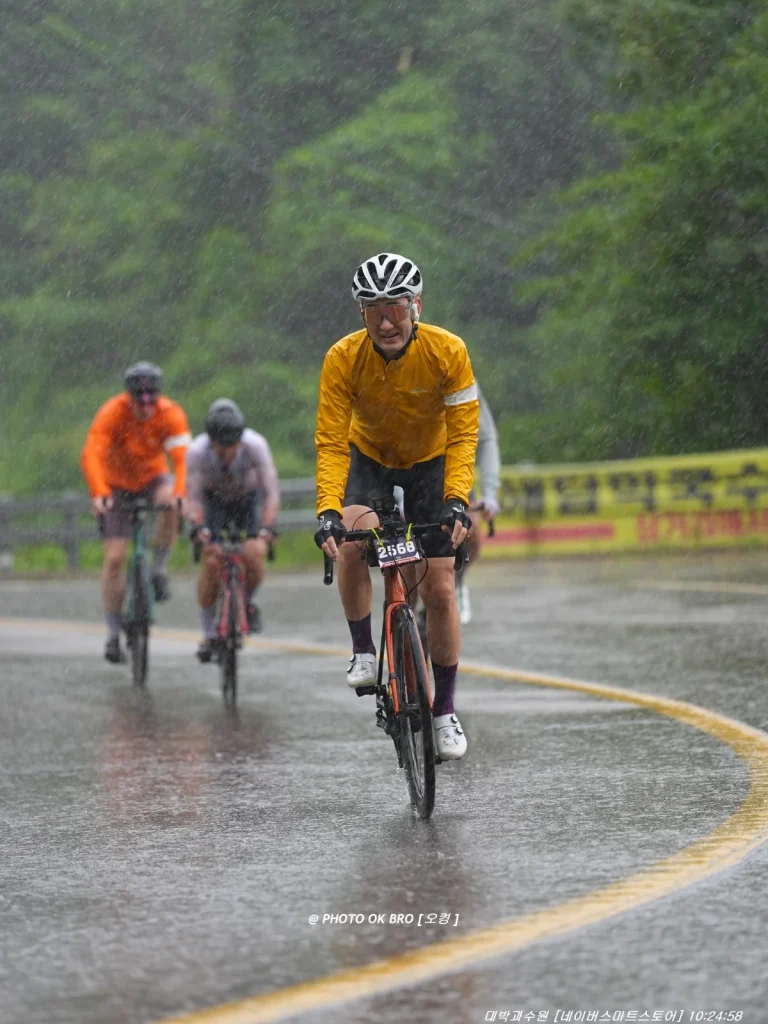
Thanks to the training ride I had done on Hwaaksan a few weeks earlier, the climb didn’t feel as intimidating as I had remembered.
In fact, maintaining my pace felt easier than it had the previous year, largely because the cool weather prevented me from overheating.
The rain never stopped.
By then, though, I had almost forgotten it was raining.
My clothes were completely soaked.
Water had filled my shoes long ago.
Yet none of it bothered me anymore.
At some point, it simply became part of the ride.

The Closed Junction
After descending from Jochimryeong Pass, the road eventually reaches the intersection at Jindong 2 Bridge.
This is where the Seorak Granfondo and Medio Fondo courses normally split.
Under normal circumstances, I would have turned right toward Sseurijae Pass and Hangyeryeong Pass.
This year, however, the road was closed.
Standing there and looking at the barrier, I couldn’t help feeling disappointed.
The course I had spent months preparing for lay just beyond that intersection.
But this year, it was simply out of reach.

The Final Aid Station
A short distance after the junction came the final aid station on the Medio course.
It had been several years since I had stopped there.
Personally, I’ve often thought that the full Granfondo course could benefit from having another aid station around this distance.
The existing Sseurijae Pass aid station has always felt slightly awkward in terms of timing and location.
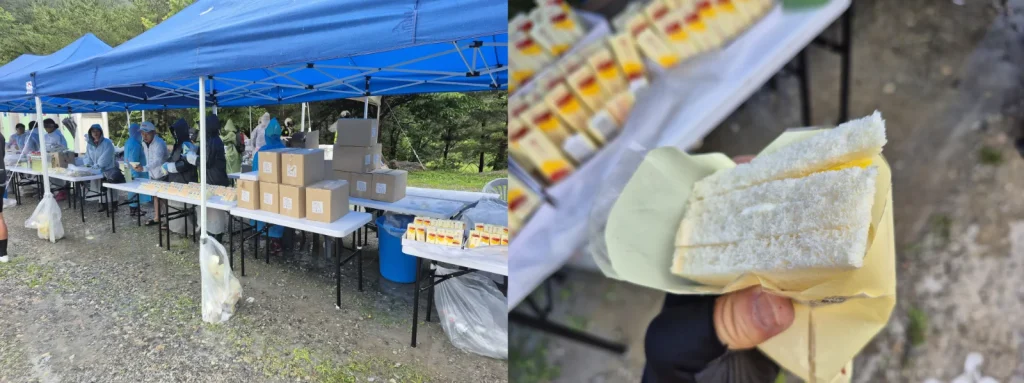
The sandwiches that had originally been prepared for the Sseurijae aid station were available here instead.
Since the finish wasn’t too far away, I only ate one.
After the ride, though, I found myself thinking,
“Maybe I should have had another one.”
They were surprisingly good.
Over Omi Pass and to the Finish
Since the course had already been shortened because of the weather, I briefly wondered whether the organizers might route us through the Omi Pass Tunnel instead of over the old road.
That didn’t happen.
The marshals directed everyone onto the original route, meaning we still had to climb the final short hill before reaching the finish.
The gradient was fairly steep, but fortunately it wasn’t very long.
Once over Omi Pass, the finish line was practically just around the corner.
The rain never stopped all day.
Compared to the morning, however, it had become much lighter and actually made riding feel more comfortable.
Because of the weather, I expected my finishing time to be much slower than usual.
In reality, I wasn’t nearly as far behind as I had imagined.
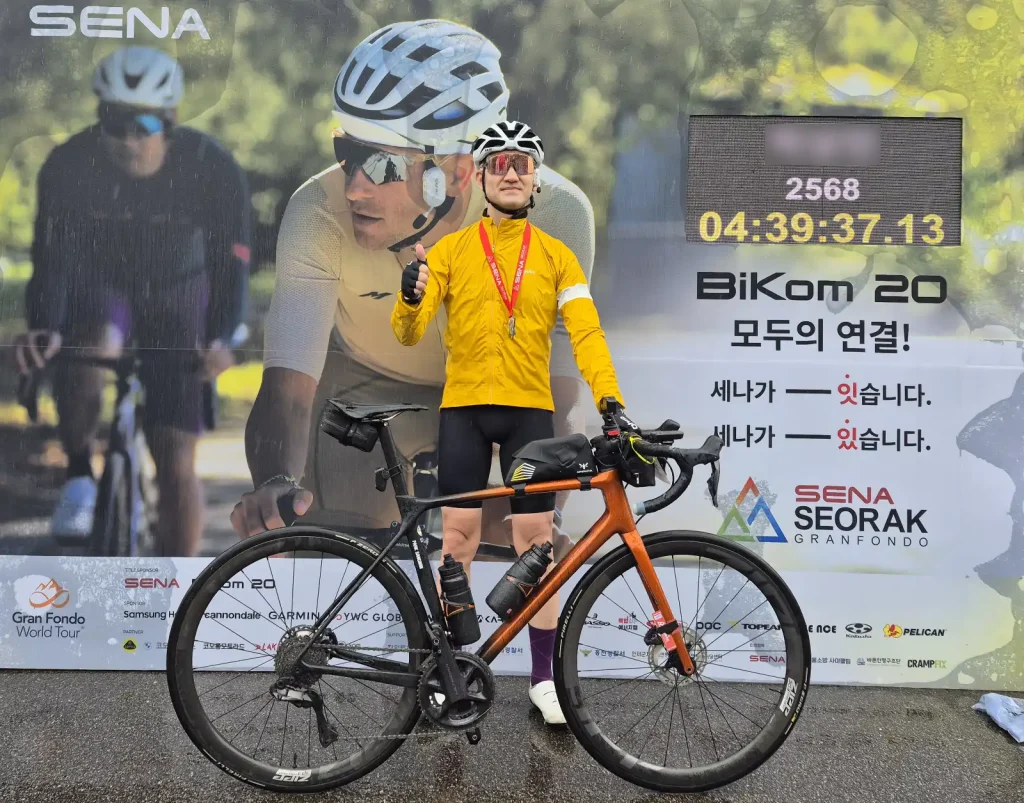
Later, when I checked my ride data, I discovered something unexpected.
My climb up Jochimryeong Pass was actually my fastest ever in all the years I’ve ridden the Seorak Granfondo.
Perhaps cool temperatures really are far more favorable for climbing than intense summer heat.
A Surprisingly Cheerful Finish Line
The first thing I noticed after crossing the finish line was the expressions on everyone’s faces.
Despite the difficult weather, most riders looked genuinely happy.
Thinking about it, that made perfect sense.
Everyone who stood there had already chosen to start despite the conditions.
On a day like this, simply making it to the finish meant more than any finishing time ever could.
Since the course had been shortened, there was also time to enjoy the event afterward.
I visited several sponsor booths that I would normally have skipped and even joined the SENA event.
One of my friends won a cap.
I received a pair of socks.
Maybe not the grand prize—but it still became another fun memory from the day.
A Shortened Seorak I’ll Never Forget
After riding in the rain from start to finish, it almost felt like my face had received an all-day rain massage.
Maybe my skin even looked a little better afterward.
Of course, I’m joking.
But that’s honestly how much rain we rode through.
The biggest disappointment, without question, was missing the opportunity to ride the full Seorak Granfondo course.
Months of preparation had been aimed at testing myself against that challenge, and that opportunity simply disappeared.
Even so, looking back now, I’m convinced I made the right decision by starting.
If I had stayed home, I would probably have regretted it for much longer.
The Medio course in heavy rain wasn’t the race I had planned for.
But it still gave me plenty of enjoyable moments and another unforgettable cycling experience.
In the end, despite everything…
I genuinely had a fantastic day on the bike.
And just like that, my 2026 Seorak Granfondo came to an end.
Whether I’ll return next year, I honestly don’t know.
The schedule has to work.
My fitness has to be there.
And above all, the weather has to cooperate.
Cycling may only be a hobby for me, but preparing for a long-distance event like this requires far more things to come together than most people realize.
Still…
If I get the chance, I’d love to come back and ride Seorak again.
One Last Job After Every Rain Ride
Whenever I return home after a rainy event, there’s always one final task waiting for me.
Cleaning the bike.
The bike has to be washed thoroughly.
Every piece of equipment needs to be taken apart and dried.
The chain and drivetrain have to be cleaned and lubricated again.
Only after finishing all of that does the event truly feel over.
And that’s how this year’s Seorak Granfondo came to an end as well.
It also added one more line to my growing list of races ridden in the rain.
- 2023 BWCK (Brompton Event) – Shortened course in the rain
- 2023 Chungju Granfondo – Shortened course in the rain
- 2024 Suti Smith Done Fondo – Rain ride
- 2025 Randonneurs Brevet “Dong Pig” 200 km – Rain ride
- 2025 Buyeo Granfondo – Shortened course in the rain
- 2026 Seorak Granfondo – Shortened course in the rain
I think I’ve had enough rainy races for a while.
Hopefully, the next one will finally come with blue skies.
A Final Note
I later learned that Oliver Bridgewood and Conor Dunne, two well-known presenters from Global Cycling Network (GCN), also took part in this year’s event. Minho from the K-pop group SHINee was there as well.
It’s a shame they had to experience Seorak under such extreme weather conditions.
On a clear day, the Seorak Granfondo is famous for its spectacular mountain scenery and some of the most beautiful roads in South Korea.
I only wish they could have seen it at its very best.
by Simon