
Location: Inje County, Gangwon State, South Korea
Event: Seorak Granfondo 2026
Distance: 208 km
Elevation Gain: Approximately 3,800 m
The 2026 Seorak Granfondo will take place on June 20, 2026 after being postponed once. With only about a week remaining, how is your preparation going?
This year’s course is identical to last year’s route.
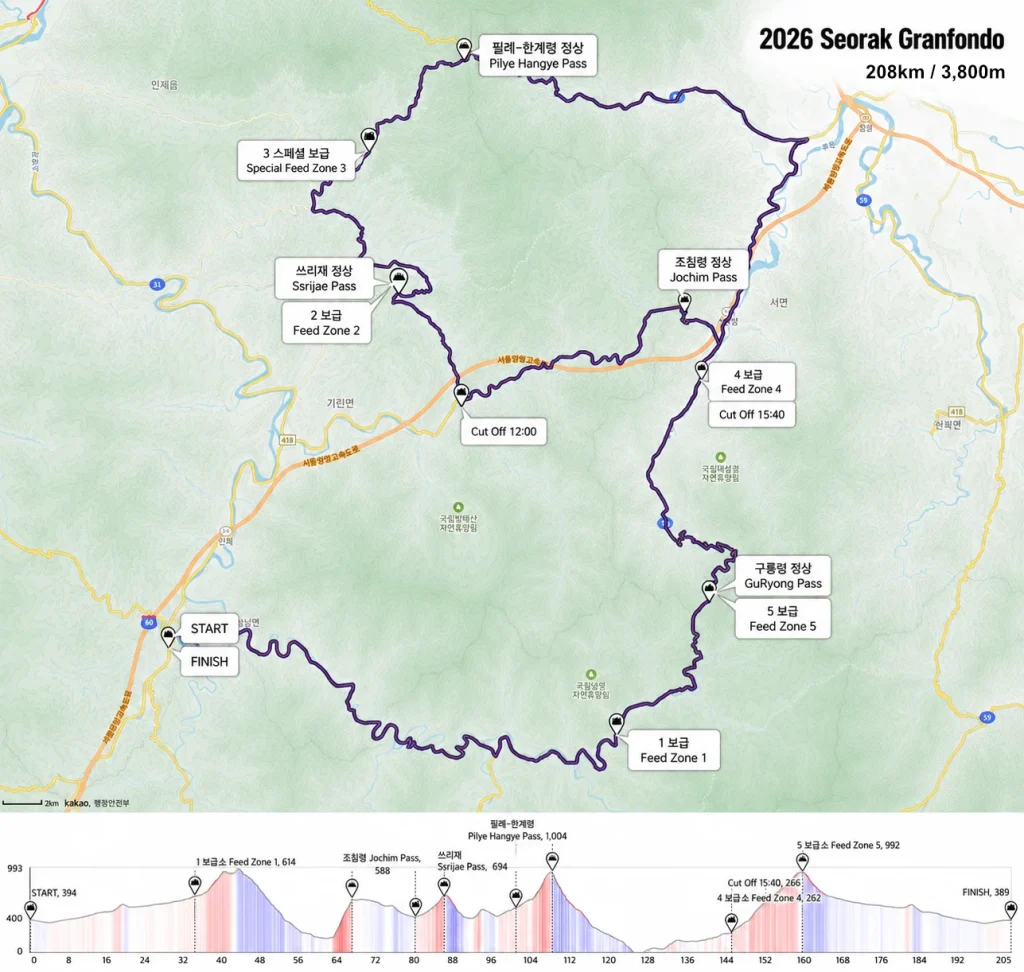
The Granfondo course covers 208 km with approximately 3,800 m of climbing. Let’s take a look at the major climbs and key sections of the course.
Course Overview
The start location remains the same as last year. Riders leave the Inje Riding Center and officially start near Sangnam Elementary School.
(Location descriptions are for reference only and may differ slightly from the actual course.)
The opening section is always crowded, so extra caution is required. About 20 km into the ride you’ll reach Saldun Pass. It is not a major climb, but because speeds suddenly drop in a dense group of riders, this section requires attention.
The first feed zone is located around the 33 km mark on the right side of the road near Saemgol Rest Area. Until 2024 it was located at the summit of Guryong Pass, but it was moved forward last year.
Personally, I feel the first feed zone is both too close to the start and often extremely crowded. I skipped it last year. Whether to stop here or ride through is something worth considering as part of your race strategy.
Guryong Pass / 37 km Start / 6.4 km at 6.1%
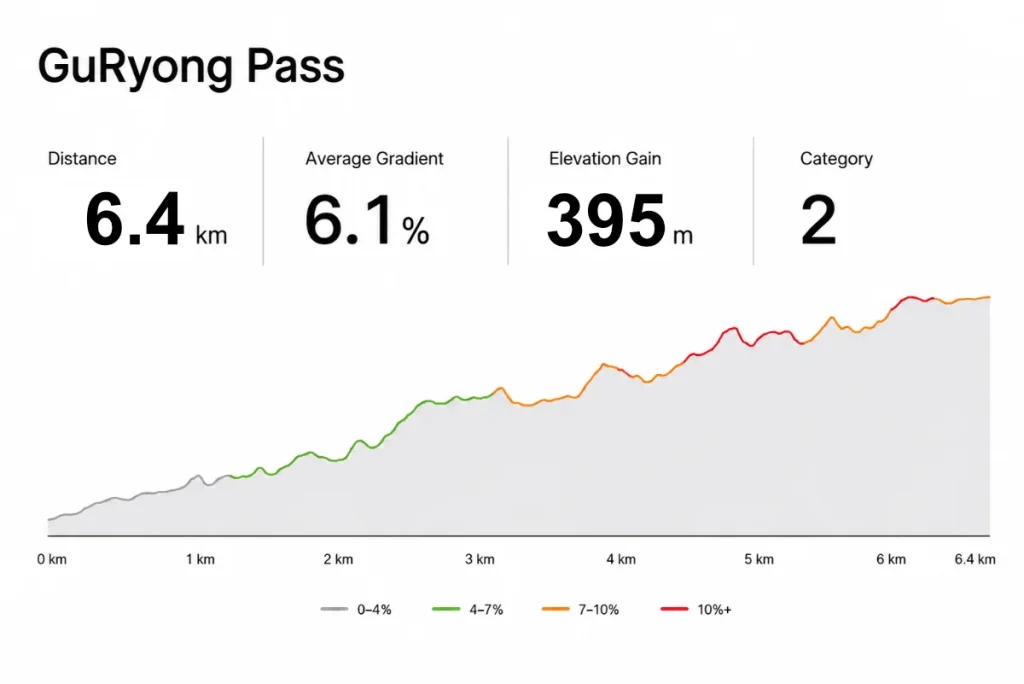
The climb begins around kilometer 37.6.
Guryong Pass is the first major climb of the day, measuring approximately 6.4 km with an average gradient of 6.1%. While it is relatively long, the gradients are generally manageable. A steady rhythm is usually enough to get over it comfortably.
The summit arrives around kilometer 44, followed immediately by a long 20 km descent.
Of course, that also means you’ll have to climb much of that elevation again later when returning from the opposite direction around kilometer 143–164. This is the famous reverse ascent of Guryong Pass.
The descent contains many blind corners. Every year there are crashes caused by excessive speed or crossing the center line, so ride carefully.
After the long descent you’ll reach Seorim Junction around kilometer 65. Turn left and you’ll immediately see a wall-like road ahead.
That is the start of Jochim Pass.
Jochim Pass / 65 km Start / 4.3 km at 10.1%

Jochim Pass is famous among Korean cyclists.
At 4.3 km long with an average gradient exceeding 10%, it is one of the steepest sustained climbs on the entire Seorak course. The gradients stay above 10% for much of the ascent, making it a true test of climbing strength.
The summit tunnel arrives around kilometer 69.
If you’re feeling strong, simply continue through. Otherwise, it can be a good place to briefly stop and take a gel or quick snack before continuing.
After passing through Jochim Tunnel and crossing Jindong Pass, you’ll eventually reach Jindong 2 Bridge Junction at approximately kilometer 82.
This is where the Granfondo and Mediofondo routes separate.
Many riders jokingly call this the “moment of temptation.”
Stay focused and turn right for the Granfondo.
This is also the first cut-off point, with a cut-off time of 12:00 PM. Riders maintaining a normal finishing pace generally should not have difficulty reaching it in time.
Immediately after the right turn, Ssrijae begins.
Ssrijae Pass / 82.7 km Start / 6.3 km at 5.2%

Ssrijae is approximately 6.3 km long with an average gradient of 5.2%.
The first 4 km are relatively gentle, making the climb feel manageable—assuming your legs have recovered from Jochim Pass.
The final 2 km become significantly steeper and require more effort.
Just when the climb starts becoming frustrating, you’ll reach the summit around kilometer 89, where Feed Zone 2 is located.
Last year the feed station offered mainly water and sports drinks, which was somewhat disappointing after skipping the first feed zone. According to the official information, this year’s station appears to include sandwiches and additional food options.
Personally, I still think a location between Guryong Pass and Jochim Pass would make more sense, but that’s another discussion.
About 10 km after Ssrijae, the next major climb begins.
Pilye–Hangyeryeong / 99 km Start / 10.5 km at 4.4%
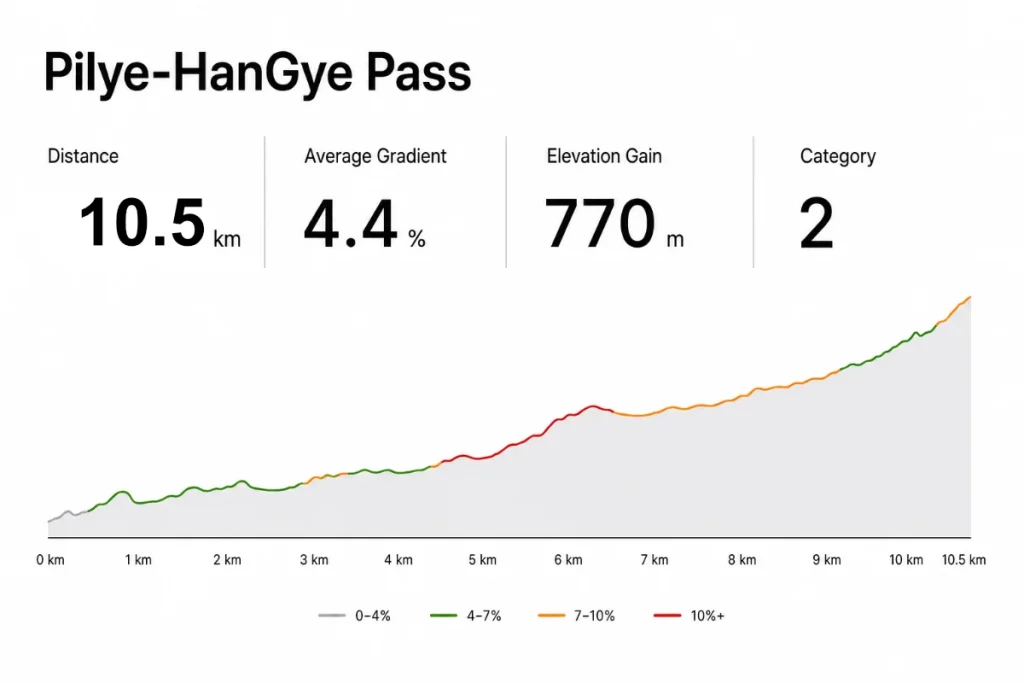
The climb from Pilye Mineral Spring toward Hangyeryeong is approximately 10.5 km long with an average gradient of 4.4%.
It is a very long climb. Although the average gradient appears moderate, the final section becomes significantly steeper.
Fortunately, the Special Feed Zone is located midway up the climb.
After approximately 5 km of gradual climbing, you’ll reach the Special Feed Zone around kilometer 104.
This station allows riders to collect personal nutrition bags that were dropped off before the event.
At this point you’ve completed roughly half of the course.
Some stronger riders choose to skip the station to save time, but personally I need a substantial refueling stop here. Everyone is different, so plan according to your own needs.
The first half of the climb is relatively comfortable.
The second half is a different story.
As you approach the summit, the gradients become noticeably steeper and eventually quite brutal.
The Pilye–Hangyeryeong summit arrives around kilometer 110.
(Note that the actual Hangyeryeong Rest Area summit is not part of the course.)
Turning right at the summit begins a long descent toward Yangyang.
This is a good opportunity to rest physically, but don’t lose concentration. Fatigue often catches up with riders here. Several years ago I even struggled with drowsiness on this descent.
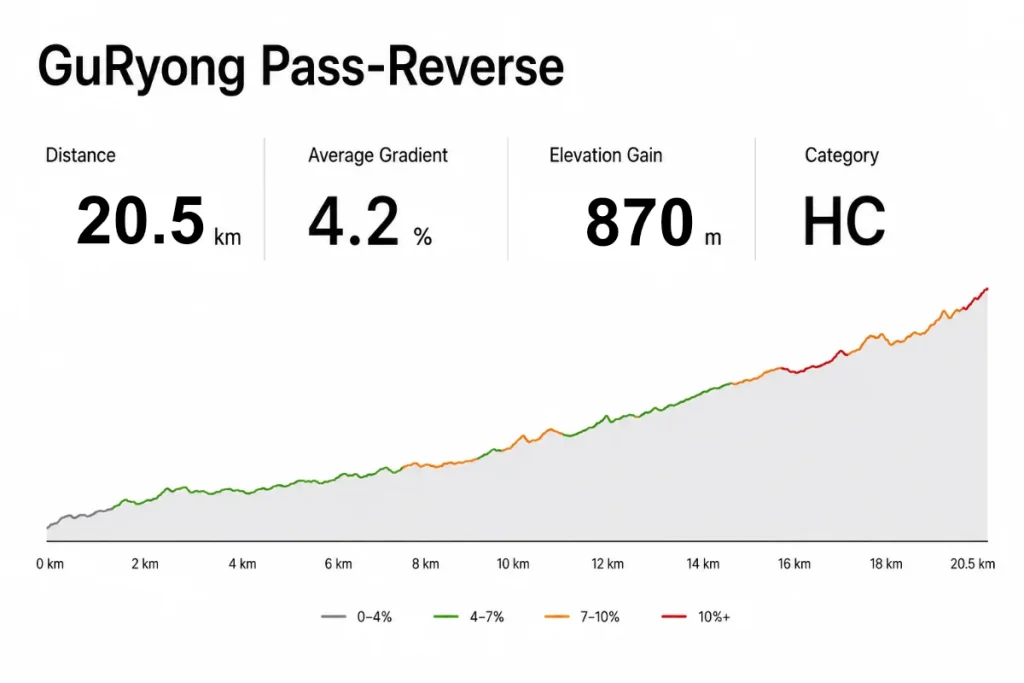
Reverse Guryong Pass / 20.5 km at 4.2% (HC)
After descending to Nonhwa Junction around kilometer 132, the route gradually heads back toward Guryong Pass.
The terrain is never truly flat. Although not marked as major climbs, numerous rolling hills gradually wear riders down.
Around kilometer 143 you’ll pass Seorim Junction again.
That means the reverse ascent of Guryong Pass begins.
This climb is approximately 20.5 km long with an average gradient of 4.2%.
Because of its length, it qualifies as an HC-category climb and is arguably the highlight of the entire Seorak Granfondo.
The first 10 km are relatively gentle.
The second half steadily ramps up, with long sections in the 7–9% range.
Around kilometer 147 you’ll reach Feed Zone 4.
Fill your bottles, cool yourself with water, and prepare for the hardest section of the day.
This is also the second cut-off point. Riders must pass before 3:40 PM (15:40).
The greatest challenge here isn’t only the climbing.
By this point you’ve already ridden roughly 145 km, and the midday sun can be relentless.
Because the event was moved from May to June this year, temperatures may be even higher than usual. Manage your hydration carefully, stay cool whenever possible, and don’t hesitate to take a short break if necessary.
After enduring the climb, you’ll finally reach the summit and Feed Zone 5 around kilometer 164.
For me, this is always an important recovery stop.
Only about 44 km remain.
The Final Run to the Finish
The last major climb is behind you.
Now the goal is simply to reach the finish safely.
The descent from reverse Guryong Pass can actually feel cool, sometimes even chilly. While the climb is fully exposed to sunlight, much of the descent remains shaded.
After approximately 6 km of descending, it’s time to squeeze out whatever energy remains.
Around kilometer 189 you’ll climb Saldun Pass again, this time from the opposite direction.
It’s short but surprisingly punchy.
Once over the top, the remaining 18–20 km are mostly flat.
Keep turning the pedals and eventually you’ll cross the finish line, bringing a long and demanding day to an end.
Final Thoughts
The Seorak Granfondo is challenging not only because of its distance and elevation gain, but also because weather conditions and nutrition strategy play major roles in the outcome.
Plan your pacing carefully, manage your hydration and fueling wisely, and most importantly, ride safely.
Good luck to everyone taking on Seorak Granfondo 2026.
by Simon